

How To Agree On Child Visitation Schedule Peacefully: A Guide for Local Parents
The process of separating your life from another person is already one of the most emotionally challenging transitions a family can go through. When children are involved, that emotional load intensifies exponentially. One element-the actual schedule and logistics-can quickly feel like an insurmountable battlefield, making you question everything about co-parenting itself. If you find yourself in this position, staring across the table (or at the phone) with a sense of mounting frustration because you simply cannot agree on who gets the kids when, please know that your feelings are completely valid.
The desire to how to agree on child visitation schedule peacefully? is not just about convenience; it is fundamentally about stability and peace for your children. We often think "peaceful" means zero disagreement, but in reality, establishing a functional routine after separation requires structured communication focused purely on the child’s best interests. This guide is designed to cut through the emotional noise, offering you a clear, step-by-step path toward creating a sustainable co-parenting plan right here in our community, whether you live in Betty Mundy's Bottom or nearby areas like Kings Worthy or Whiteley.
When co-parenting feels like navigating a difficult village high street
It’s easy to feel overwhelmed when the very concept of scheduling seems fraught with conflict. The reality is that disagreements over who gets time, where handovers occur, and how holidays are divided are some of the toughest, most emotionally charged conflicts we encounter during separation. It can feel exactly like trying to coordinate every single person in a bustling village high street-there's just too much moving at once!
First, let’s acknowledge that stress is immense. Before we talk about solutions, you need validation: it is okay to feel frustrated. The goal of this process is not for either parent to admit who was "right" or "wrong" during the marriage; it is simply to build a predictable, reliable structure that allows your children to thrive.
This brings us to reframing what "peaceful" really means in legal terms. It doesn't mean you never have a difference of opinion again-because differences are normal part of adult life! Instead, it means adopting a structured communication framework focused solely on the child’s emotional and physical stability. A good co-parenting plan is less about who gets to win an argument and more about establishing a sustainable rhythm, like knowing exactly when the school bus arrives every weekday morning.
To start moving forward, we need initial self-assessment. Ask yourself: Why are we really disagreeing? Is it purely logistical (e.g., one parent lives further away)? Or is there an underlying issue attached to time-perhaps financial concerns, or maybe a struggle for emotional control over the narrative of the separation? Understanding the root cause of the deadlock is always step one toward finding clarity and moving past blame.
Moving beyond arguments: The structured path to a co-parenting plan
When conflict gets heated, it’s incredibly common to hear phrases like, "The only way we can sort this out is through court." This fear-that litigation is the only reliable option-is perhaps the biggest barrier people face. However, for parents who are committed to their children's welfare but struggle with direct communication, there is a powerful and specialized alternative: Child Arrangement Mediation.
Mediation should not be viewed as giving up or conceding; it is viewing the problem through a highly skilled professional’s lens. It is an investment in your family's future stability that often saves significant time and money compared to court proceedings.
Defining Child Arrangement Mediation
What exactly happens? Simply put, mediation is a structured conversation led by a neutral expert-the mediator. This person acts like a highly competent translator, taking all the raw emotion, accusation, and history you both bring into the room, and filtering it out until only practical logistics remain. They don’t tell you what to agree on; they guide you toward finding solutions that work for your specific life circumstances in the Hambleton Area.
Instead of negotiating terms-which sounds like a battle-think of it as setting up a reliable routine. You are working with the mediator to build a predictable schedule, much like setting up a new rhythm for school drop-offs and pick-ups that works reliably year-round. The mediator’s primary job is to keep the focus strictly on practicalities: When does soccer practice happen? Who handles dentist appointments? How do we manage Christmas without it becoming another source of stress?
What to expect in the process
The process itself is designed for clarity and minimal overwhelm. You can expect a structured flow:
- Initial Chat: A preliminary meeting with the mediator to ensure you both feel this path is right for you.
- Information Gathering: Bringing all current schedules, existing agreements (if any), and practical needs to the table.
- Structured Discussion: The core mediation sessions where the mediator leads focused discussions on specific topics (e.g., "School Term Schedule," then "Holiday Allocation").
- Drafting the Agreement: Working together with the mediator to draft a clear, written Parenting Plan.
This structured approach means you are always moving forward and never getting stuck in circular arguments about who should have been right all along. It keeps your focus on the future, not the past.
Building your agreement: Practical details for successful child visitation schedules
A truly robust parenting plan is far more detailed than just a list of dates. If you simply agree that Parent A has the kids every other weekend, but forget to mention what happens when those weekends clash with school half-term breaks or major sporting events, the agreement is incomplete and prone to conflict. Successful co-parenting requires anticipating disruption.
We need to think in terms of a comprehensive "Template" approach. This means covering:
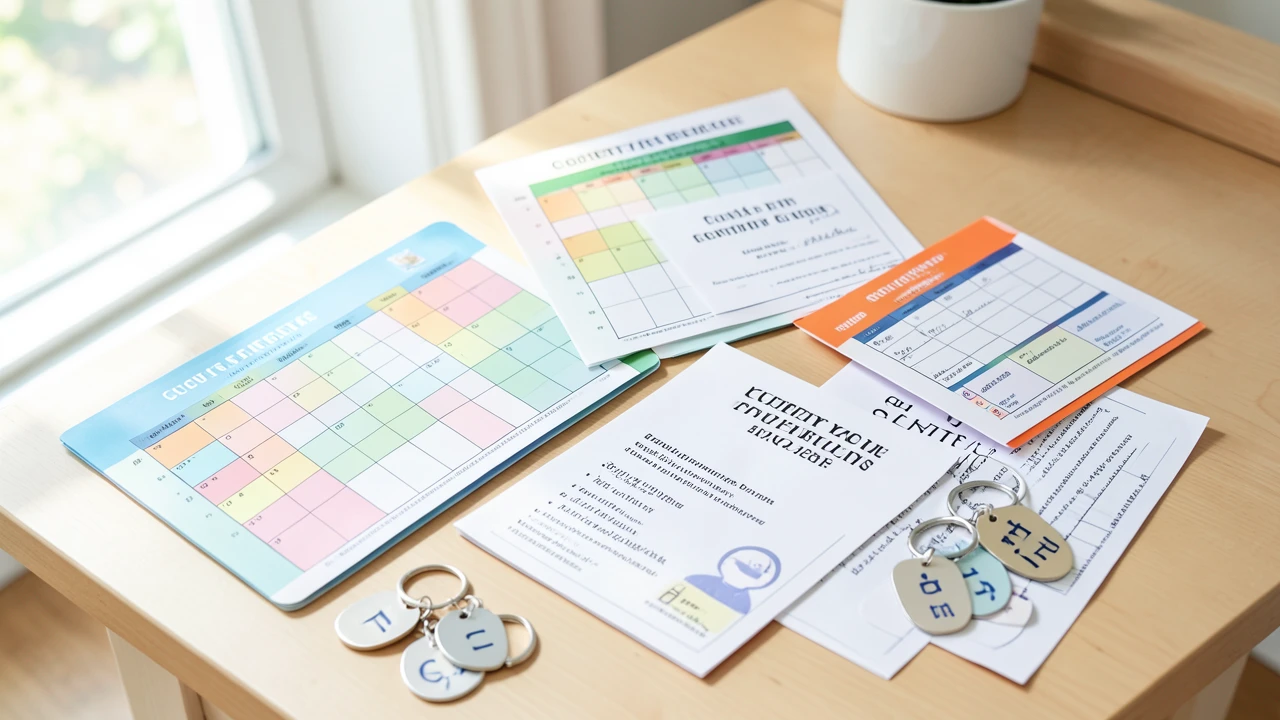
- The Schedule Backbone: The standard weekly routine (e.g., every other weekend).
- Handovers: Specific, low-conflict rules for exchanges-who drops off where, and at what time? This eliminates the awkward "Who is responsible for the school gate drop-off?" debate.
- Communication Protocols: Establishing a single, agreed-upon method of communication (like a shared co-parenting app or designated text times) to keep discussions factual and limited to the child’s needs.
- Emergency Procedures: Who is called if something happens outside of normal hours? Having these clear out front reduces panic when unexpected events occur.
Managing the holidays and disruptions
The holiday period is where most agreements fail because they only focus on the "normal" year. This is where you must pre-plan major gaps in routine. Instead of waiting until Christmas Eve to argue who gets which day, use mediation to map out a clear annual calendar that allocates specific time blocks for:
- Christmas (e.g., alternating years).
- Easter (e.g., basing it on the school schedule).
- Summer Breaks (dividing them equitably between parents).
This level of detail is critical because consistency is key. Consistency provides stability-the single most important factor for a child's mental and emotional well-being. When the routine is stable, both you and your children feel more secure, allowing you to finally start thinking about how to agree on child visitation schedule peacefully without constant worry.
Anecdote Break: I remember working with a wonderful family near Calmore who had gone through years of fighting over summer holidays. They thought they were arguing over dates, but the mediator helped them realize they were actually fighting over "control." By structuring their time into clearly defined annual chunks (e.g., Parent A gets all of June; Parent B gets all of August), the argument vanished because the structure gave them what they needed: predictable peace.
When communication breaks down: Handling high conflict arrangements
If you are reading this, chances are your current communication style is fraught with tension-you might find yourselves exchanging emails that feel more like legal demands than parental updates. This is normal in high-conflict situations, but it doesn't mean the process must remain adversarial.
Preparing for the difficult talks
Preparation is your most powerful tool. Before you even walk into a mediation session, gather your thoughts and materials. Do not go armed with grievances. Instead, prepare:
- A list of facts: What are the current dates? What schools do the children attend? Write these down in bullet points-non-emotionally.
- Your non-negotiable needs: If you need to maintain a steady routine for school pick-ups, write that down as a logistical necessity, not an emotional demand.
The mediator’s role in de-escalation
This is where the trained professional shines. Their job is literally to manage the tension and keep the conversation focused when emotions run high. They are objective guides who gently steer you back to the practical task at hand when one of you starts to blame, accuse, or dwell on past hurts.
Remember this fundamental shift in focus: The goal isn't determining who caused the breakup; it’s building a realistic future plan that works for everyone involved. This perspective-focusing purely on co-operation and the child's needs-is what allows parents to genuinely move toward agreeing on a visitation schedule peacefully.
Quote Inspiration: As I often tell my clients, "The most successful outcomes are built on realistic future plans, not nostalgic memories of what used to be." This quote perfectly captures why we must remain grounded in the practical needs of your children while mediating.
Taking the next step toward a stable co-parenting routine
Achieving this stable arrangement is entirely possible, even if it feels impossible right now. The structured conversation offered by Child Arrangement Mediation provides a low-stakes, high-support environment designed precisely for parents like you-those committed to their children but exhausted by conflict.
If you are grappling with the question of how to agree on child visitation schedule peacefully?, remember that our local services are specifically tailored to make this process accessible and manageable. We understand how daunting legal processes can feel, which is why we emphasize starting with an initial consultation-this is simply a supportive chat where you gather information without any commitment or pressure.
Furthermore, many people assume mediation only handles the schedule. Not at all. If property division or financial arrangements are also causing friction, a mediator can often help structure those discussions too, preventing the need for multiple legal processes and saving you valuable time and money compared to going straight to court.
The final step is commitment-a mutual commitment to putting the children’s stability above your own need to be “right.” By choosing this structured path, you are investing in a future where routine is predictable, communication is fact-based, and your family can begin to heal together. We are here in Betty Mundy’s Bottom area to guide you through every step of establishing that calm, stable co-parenting rhythm.